Dental Implants and Mini Dental Implants
What are Dental Implants?
Dental Implants have been used successfully for many
years. The implant itself is a post that is surgically placed in
the jaw. A prosthesis (artificial tooth or teeth) is then attached
to the post. Dental implants involve cooperation between an surgical
specialist and our office. The surgical phase of treatment is completed
by the surgical specialist, and the restorative phase is completed
at our office.
What are Dental Implants Used For?
Dental Implants are used to replace missing teeth
and to retain removable prostheses.
What are Mini Implants?
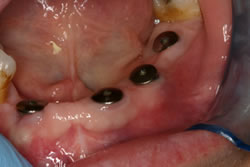
Mini dental implants are very strong, small, titanium screws
that are approximately the size of wooden toothpicks. They
can be used to anchor dentures for a more secure fit.
Dr. Huff
will first do an exam or consultation to determine how many
mini-implants you will need. Then under mild anesthesia the
mini-implants are gently placed. A denture is then created
to fit over and "snap" onto the implants, resulting
in a tight fitting denture that doesn't "float"
around the mouth interfering with speech and trapping food
underneath.
Visit the IMTEC site for more
information on Mini Dental Implants
|
|
What Are the Benefits of Dental Implants?
Implants allow the replacement of a single or multiple
teeth without relying on any adjacent tooth for strength or support.
Implants are generally considered as an alternative to Dentures,
Partials, or Bridges.
One important benefit of implants when used for Implant-Retained
Dentures is that they slow the shrinking of bone and gum tissue
under the denture.
- Of Americans between the ages of 18 and 64, approximately 49%
are missing at least one tooth.
- Dental implants are the most advanced tooth replacement system
ever devised.
- More than nine out of ten implants last longer than 15 years.
- Dental implants never develop decay.
- Dental implants never require root canals.
- Dental implants preserve the jawbone, which can prevent premature
aging.
- No one can be disqualified for implant treatment solely because
of their age -- some patients receive implant treatment when they
are in their nineties!
Back to Top
How Are Dental Implants Placed?
Step
One:
The gum is gently folded back and a space is prepared
for the implant to be placed.
Step
Two:
The dental implant "anchor" is put into
place.
Step
Three:
A temporary cap is placed on the implant and the gum
tissue is repositioned around the implant.The implant is left alone
for several months so the bone can attach to the implant and create
a secure anchor.
Back to Top
Step
Four:
After the implant has had a chance to attach to the
bone tissue, the temporary cap is removed from the anchor and a
post is attached to the anchor.
Step
Five:
The implant is now ready for a prosthesis. An impression
is taken of the implant and the appropriate prosthesis (crown,
bridge or overdenture)
is made.
Step
Six:
The prosthesis (artificial tooth or teeth) is then
attached to the implant(s).
Considering a Dental Implant?
If you are considering a dental implant, Contact
Us for an evaluation appointment. Dr. Huff
will perform an evaluation to determine whether you are a good candidate
for a dental implant. If you are a good candidate for an implant,
Dr. Huff
will provide you with further information to help you decide if
you should have a dental implant.
Back to Top
|